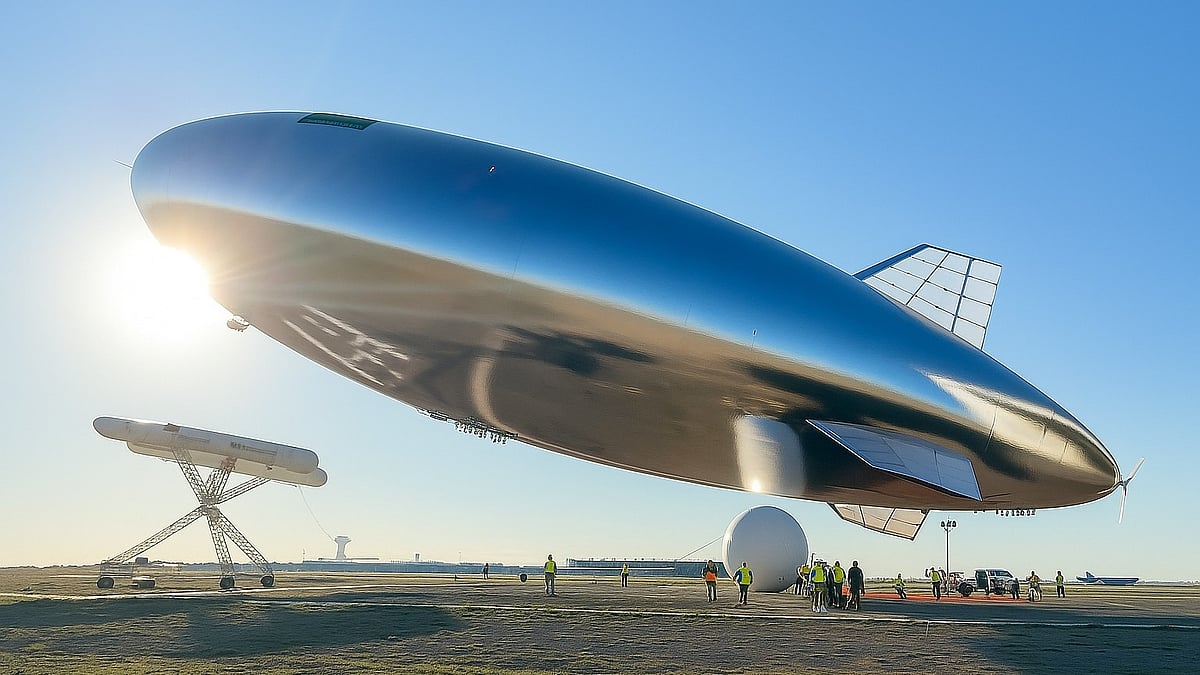
Sceye HAPS Specifications Including Endurance, Payload And Breakthroughs In Battery
1. Specifications Let You Know What the Platform Will Actually Do
There’s a tendency within the HAPS sector to talk about ambitions instead of engineering. Press releases explain coverage areas partnerships, coverage areas, and commercial timelines, but the harder and more relevant discussion is about specifications, what the vehicle actually does as well as how long it stays up, and what energy systems make continuous operation feasible. For anyone trying figure out the extent to which a stratospheric-sized platform is truly mission-capable, or is still in the prototyping phase, Payload capacity, endurance rates and battery performance are the areas where the real substance is. Vague commitments to “long endurance” and “significant payload” aren’t difficult. Delivering both simultaneously at high altitude is the engineering hurdle that differentiates legitimate programs from bold statements.
2. Lighter-Than-Air Architecture Changes the Payload Equation
The primary reason Sceye’s design is able to transport a substantial payload is buoyancy carries out the fundamental task of keeping the car airborne. This is not a nebulous distinction. Fixed-wing solar planes need to create aerodynamic lift on a continuous basis this consumes energy, and has structural constraints that limit how much extra weight the vehicle can transport. A floating airship within the stratosphere, doesn’t need to use energy fighting gravity in the same way – meaning that the power produced by its solar array, and the structural strength of the vehicle could be geared towards stations keeping, propulsion and payload operation. The result is a payload capacity that fixed-wing HAPS designs with comparable durations really struggle to match.
3. Capacity of Payload Determines Mission Versatility
The actual significance of higher payload capacities is evident when you think about what the stratospheric projects actually call for. The payload of telecommunications — antenna systems, signal processing hardware, beamforming equipment — carries real weight and size. So does a greenhouse gas monitoring suite. The same goes for a wildfire detection and earth observation sensors package. Running any one of these missions efficiently requires hardware that’s mass. Multi-tasking requires more. Sceye’s airship specs are designed around the principle that a spacecraft should be capable of carrying a useful combination of payloads rather than requiring users to choose between connectivity and observation because the vehicle doesn’t have enough space to accommodate both simultaneously.
4. Endurance is where Stratospheric Missions win or lose
A platform that can reach high altitudes for a period of at least 48 hours before having to descend is useful for demonstrations. An elevated platform that remains in place for a long period of time it is very useful in creating commercial services. The difference between the two options is essentially the energy aspect — specifically, whether or not the vehicle is able to generate enough solar power during daylight to operate all systems and charge its batteries enough to provide all functions throughout the night. Sceye endurance targets are based around this challenge during the day making sure that overnight energy is considered not as a flimsy goal but as a fundamental specifications that everything else is designed around.
5. A Genuine Step In the Right Direction
The battery chemistry powering conventional electronic devices and electric vehicles, particularly lithium-ion. It has energy density characteristics that can cause limits for endurance applications in the stratospheric. Every kilogram of battery mass carried high is a kilo of energy not available for payload, but you’ll need enough energy to keep a large device operating all night. Lithium-sulfur-based chemistry alters this dilemma dramatically. At energy densities as high as 425 Wh/kg. lithium-sulfur based batteries can hold significantly more energy per pound than similar lithium-ion devices. For a vehicle weighing a lot, in which every gram of battery mass has an opportunity cost in payload capacity rise in energy density isn’t simply incremental but is actually architecturally significant.
6. New advances in the efficiency of solar cells are the Other Half of the Energy Story
The energy density of the battery is the measure of how much power you are able to store. The efficiency of solar cells determines the speed at which you replenish it. Both are important and progress with one without growth in the other results in a more lopsided energy structure. The advancements in high-efficiency photovoltaic cells that include multi-junction designs that harness a greater spectrum of solar energy, compared to traditional silicon cells — have substantially improved the amount of energy harvested by solar-powered HAPS vehicles in daylight hours. With lithium-sulfur storage, these improvements are what makes the closed power loop possible: creating and storing enough energy every day for all devices to operate indefinitely without any external energy input.
7. Station Keeping Draws Constantly from the Energy Budget
It’s easy enough to define endurance solely as remaining in the air. However, for the stratospheric platforms, staying airborne is only part of the equation for energy. station keeping — maintaining its position against the prevailing winds by continuous propulsion draws power constantly and represents the largest portion of energy consumption. The energy budget must include station keeping as well as payload operation, avionics, thermal management, and communications systems all at once. This is why specs that provide endurance figures without describing the specific systems operating in that time are hard to judge. Genuine endurance figures assume full operational load, not a just a minimally configured vehicle, with payingloads disabled.
8. The Diurnal Cycle Is the Design Constraint Everything Else Runs From
Stratospheric engineers are discussing the diurnal period — which is the day-to-day rhythm of the availability of solar energyas the main limitation around which the platform is built. During daylight the solar array must generate enough energy to power all the systems and recharge the batteries sufficiently. When night falls, the batteries need to sustain the entire system until sunrise, and without falling off its position, deteriorating its payload’s performance, or going into any kind of reduced-capability mode that could disrupt a continuous monitoring or connectivity mission. The design of a vehicle that can thread the needle in a consistent manner every day of the week, for months at a time is the primary technical challenge facing solar-powered HAPS development. Every single specification choice (solar array area and battery chemistry, propulsion efficiency, power draw for the payload -all feed into this one key constraint.
9. It is the New Mexico Development Environment Suits This Kind of Engineering
Developing and testing a stratospheric airship requires infrastructure, airspace, and atmospheric conditions which aren’t all available. Its location in New Mexico provides high-altitude launch and recovery capabilities, clean skies that allow solar research plus access type of unrestricted, uninterrupted airspace tests on flight for sustained periods of time. Within the field of aerospace companies in New Mexico, Sceye occupies an undisputed position focusing on stratospheric lighter air techniques rather than program for rocket launches that are usually linked to New Mexico. Its engineering rigor to confirm endurance claims and battery performance in actual stratospheric conditions is exactly the kind of work that can be benefited from a specially-designed test environment and not opportunistic flying campaigns elsewhere.
10. Specifications that withstand Inspection Are What Commercial Partners have to know.
The primary reason specs matter, beyond technical concern, is that commercial partners making investment decisions must ensure whether the numbers are factual. SoftBank’s commitment to a nationwide HAPS networks in Japan which will offer pre-commercial services in 2026, is predicated on the belief that Sceye’s platform is capable of performing as intended in operating conditions and not just during controlled tests, but sustained throughout the mission durations that commercial networks need. Payload capacity which is robust with full telecommunications and observation suites the aircraft, endurance statistics that are validated with actual stratospheric operations, as well as battery capacity demonstrated over diurnal cycles is what will transform a promising aerospace programme into the infrastructure major telecoms operator is prepared to stake its network plans on. View the recommended non-terrestrial infrastructure for more tips including aerospace companies in new mexico, HAPS investment news, softbank pre-commercial haps services japan 2026, sceye lithium-sulfur batteries 425 wh/kg, Closed power loop, Mikkel Vestergaard, Cell tower in the sky, detecting climate disasters in real time, sceye disaster detection, what are the haps and more.
Search For Wildfires And Other Disasters From The Stratosphere
1. The Detection Window is the Most Useful Thing You’ll Be able to Extend
Every major disaster is accompanied by a moment that may be measured in moments, but often in hours when the early awareness could have altered the outcome. A wildfire that is discovered when it extends to half an hectare is an issue with containment. This same fire when it covers fifty acres is a crisis. An industrial gas leak that is discovered within the first few minutes could be secluded prior to it becoming a public health emergency. The same issue that is discovered after three hours, either through any ground-based report or satellite flying by during its scheduled visit, has already changed into a situation that has no clear solution. The extension of the detection window is one of the best element that improved monitoring infrastructures give, and maintaining observations of the stratospheric sphere is among the few methods that alters the window to a significant degree rather than minimally.
2. It is becoming harder for wildfires to monitor with the existing infrastructure
The scale and frequency of wildfires of recent decades has outpaced the monitoring system designed to monitor them. Networks of detection based on ground — watchtowers, sensor arrays, ranger patrols do not cover enough territory and work and are not fast enough to stop rapid-moving flames in the beginning stages. Aircrafts are efficient but expensive, weather-dependent and reactive instead of anticipatory. Satellites move over a area according to a frequency measured in hours, which means a fire which ignites to spread, then gets a crown, and continues to grow between passes will not give any warning at all. The combination of more fires in rapid spread rate driven by drought conditions, and complicated terrain can create a monitoring gap that traditional approaches aren’t able to close.
3. Stratospheric Altitude Provides Persistent Wide-Area Visibility
A platform that is operating at a height of 20 kilometres above ground can guarantee continuous visibility over a large area of ground covering several hundred kilometers covering areas that are prone to fire, coastlines, forest margins, and urban interfaces without interruption. It is not like an aircraft and doesn’t require a return trip to replenish fuel. In contrast to satellites it doesn’t fade into the sky on a repeat cycle. For the purpose of wildfire detection specifically this continuous wide-area view means that the system is monitoring when it starts to ignite, and watching while the initial spread happens, and watching for changes in fire behavior — providing a continuous data stream rather than a collection of disconnected snapshots emergency managers must cross-check between.
4. Heating and Multispectral Sensors are able detect fires before smoke becomes visible.
Some of the most beneficial technologies for detecting wildfires doesn’t have to wait long for smoke that is visible. Thermal infrared sensors identify heat changes that could indicate ignition before the fire has created any visible sign of it by detecting hotspots in dry vegetation and smouldering fires in the forest canopy and the initial flames’ heat signatures as they begin to spread. Multispectral imaging further enhances the capability through the detection of changes in vegetation state — stress on moisture as well as browning, drying and drynessindications of increased the risk of fire in certain regions before the ignition event takes place. A stratospheric based platform that carries this combination of sensors gives an early warning of active ignition and an underlying prediction of where the next ignition is most likely, which is a qualitatively unique kind of situational awareness than conventional monitoring.
5. Sceye’s Multi Payload Approach Combines Detection With Communications
One of the real-world complications of major disasters is that the infrastructure people depend on to communicate like mobile towers internet connectivity, power lines — is usually one of the first elements to be destroyed or overwhelmed. The stratospheric platform, which includes disaster detection sensors and telecommunications payloads will address this problem from a single vehicle. Sceye’s strategy for mission design uses observation and connectivity as complementary functions rather than competing ones, which means the device that detects a expanding wildfire, can also offer emergency communications to personnel who are on the ground and whose terrestrial networks are dark. The wireless tower in the skies doesn’t just watch the destruction It also keeps people connected by it.
6. In the event of a disaster, detection extends far beyond Wildfires
While wildfires represent one of the most appealing scenarios to monitor the stratospheric environment over time, similar capabilities are available to a wider range of disaster scenarios. Floods can be tracked through the evolution of floods across the coastal zones and river systems. Earthquake-related aftermaths — such as affected infrastructure, blocked roads and people displacedcan benefit from a rapid, wide-area assessment that ground-based teams cannot do quickly enough. Industrial accidents that release polluting gases and toxic gasses in coastal waters produce signs that are detectable by appropriate sensors at the stratospheric height. Detecting climate disasters in real time across types of categories requires a system that is always on, always watching, and able to distinguish between normal environmental variation as well as the indicators of developing emergency situations.
7. Japan’s Disaster Profile Makes the Sceye Partnership Especially Relevant
Japan is a major participant of the world’s major seismic phenomena, is subject to regular typhoon seasons affecting populated coastal areas, and is a victim of witnessed a number of industrial accidents that require quick environmental monitoring. The HAPS partnership in between Sceye and SoftBank, targeting Japan’s nationwide network and services that will be available in 2026, sits right in the middle of high-speed connectivity to the stratosphere and monitoring capabilities. A nation with Japan’s disaster exposure and technological sophistication might be the best early adopter of stratospheric infrastructure combining robust coverage with real time observation which provides both the core communications system that emergency response relies upon and the monitoring layer required by early warning systems.
8. Natural Resource Management Benefits From the same Monitoring Architecture
The ability to detect and persist used by stratospheric platforms in preventing wildfires and detecting disasters are directly applicable to natural resource management. These functions operate over longer periods of time, but need similar monitoring continuities. Forest health monitoring -monitoring disease spread and illegal logging practices, as well as vegetation changes — benefit from continuous observation that can detect slow-developing risks before they become severe. Monitoring of water resources across large catchment areas, coastal erosion tracking, and the surveillance of protected areas against interference all have applications where a spherical platform continuously can provide actionable data that satellite passes or expensive aircraft surveys can’t be replaced cost-effectively.
9. The Mission of the Founders Shapes Why It is essential to identify disasters.
Understanding why Sceye has a particular emphasis on disaster detection and environmental monitoring and monitoring of environmental conditions — rather than looking at connectivity as the primary mission and observation as an added benefitit is necessary to understand the original perspective that Mikkel Vestergaard brought to the company. The experience of applying modern technology to the most complex humanitarian challenges creates a different set of objectives than a commercial telecommunications focus would. This capability for detecting disasters cannot be added to a connectivity platform for the purpose of adding value. It’s a statement of belief that stratospheric infrastructure should be actively used in cases that arise — climate crisis, environmental issues, emergency situations, and humanitarian crises where the earlier and more precise information alters the outcomes for those affected.
10. Persistent Monitoring Changes the Relationship between Data and Decision
The more fundamental shift that stratospheric disaster detection can bring about doesn’t involve a speedier response to individual events it’s also a change of how decision makers perceive the environmental risk over time. If monitoring is not continuous, it is possible that decisions on resource deployment, evacuation preparation, and infrastructure investments must be taken under a great deal of uncertainty regarding what’s happening. If monitoring is ongoing the uncertainty gets a lot more pronounced. Emergency managers who use real-time information feeds from an unreliable stratospheric station above their responsibilities are making their decisions from a substantially different perspective to those relying upon scheduled satellite passes and ground reports. This shift from periodic snapshots to continuous information-sharing is the reason that stratospheric geo-observation by means of platforms such those developed by Sceye to be truly transformative rather than more incrementally valuable. Follow the most popular sceye haps airship status 2025 2026 for site tips including what haps, sceye haps airship status 2025 2026 softbank, sceye haps softbank partnership details, what haps, space- high altitude balloon stratospheric balloon haps, sceye careers, Direct-to-cell, softbank haps pre-commercial services japan 2026, Wildfire detection technology, natural resource management and more.